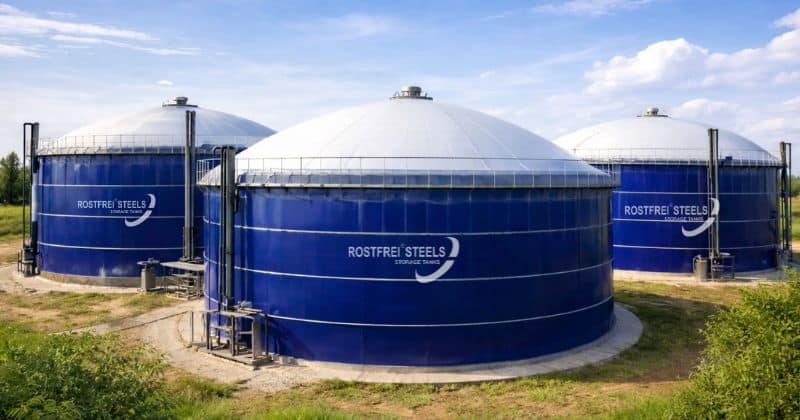
Modular / Bolted steel tanks are widely used across industries for storing liquids, like fire safety water, drinking water, rainwater wastewater, mild chemicals, and process liquids. Their popularity comes from advantages such as modular construction, faster installation, scalability, and ease of transportation. However, one critical factor that determines the success or failure of a bolted tank installation is often overlooked the RCC (Reinforced Cement Concrete) foundation.
A bolted tank, no matter how well designed or manufactured, will not give desired results as intended if it is installed on a poorly designed or poorly executed foundation. In fact, most premature failures of bolted tanks such as leakage, shell deformation, bolt loosening, and gasket failure can be directly traced back to foundation-related issues.
This article explains in detail why a well-constructed RCC foundation is essential for bolted tanks, how it affects tank performance, safety, and service life, and what key engineering considerations must be followed during design and construction.
What is an RCC Foundation for Bolted Tanks?
An RCC foundation is a reinforced concrete structural base designed to support the total load of the tank. In other words, the RCC foundation acts as an anchor for the tank, securely connecting it to the earth and providing stability against overturning, sliding, wind loads, and seismic forces.
Unlike simple PCC or earthen bases, RCC foundations provide a much stronger and more reliable base. A pocket-type structure is designed in the foundation, where the tanks are anchored using mechanical or chemical fasteners.
Finally, the complete tank base is sealed using special cement and industrial sealants to ensure long-term stability, durability, and leak prevention.
- Full circular RCC slab
- RCC ring wall foundation
The selection depends on tank type & application.
Why RCC Foundation Is So Important for Bolted Tanks?
- Uniform Load Distribution
Bolted tanks impose significant loads on the foundation, including:
- Dead load of steel plates, bolts, roof, and accessories
- Live load due to stored liquid
- Additional loads from maintenance and operational activities
An RCC foundation ensures uniform distribution of these loads across the soil. Without proper load distribution:
- Localized settlement may occur
- Tank bottom plates may deform
- Bolts and gaskets experience uneven stress
This can lead to leakage and structural distress over time.
- Prevention of Differential Settlement
One of the most common causes of bolted tank failure is differential settlement. If one portion of the foundation settles more than another:
- Tank shell becomes out of round
- Vertical joints experience excessive stress
- Gaskets lose compression
- Bolts loosen or shear
RCC foundations, when designed correctly, minimize settlement and help maintain geometric integrity of the tank throughout its service life.
- Structural Stability Against Wind Loads
Bolted tanks, especially tall tanks, are exposed to wind forces that create:
- Overturning moments
- Horizontal shear forces
- Uplift forces at the base
RCC foundations provide sufficient mass and rigidity to resist these forces. Anchor bolts embedded in RCC concrete help secure the tank shell and prevent uplift or sliding during high wind conditions.
This is especially important for:
- Fire water tanks
- Elevated or tall tanks
- Tanks installed in coastal or cyclone-prone regions
- Seismic Safety and Earthquake Resistance
In seismic zones, tanks are subjected to dynamic forces due to ground motion and sloshing of liquid. These forces act both horizontally and vertically.
An RCC foundation plays a vital role in:
- Absorbing seismic energy
- Preventing sliding or overturning
- Maintaining anchorage integrity
Without a properly designed RCC foundation, even a moderate earthquake can cause:
- Shell buckling
- Anchor bolt failure
- Tank collapse
- Ensures Proper Bolt and Gasket Performance
Bolted tanks rely on:
- Precise bolt tension
- Uniform gasket compression
A flat, level RCC foundation ensures:
- Correct alignment of bottom plates
- Uniform compression across all joints
Even small undulations or slope errors in the foundation can result in:
- Uneven bolt stress
- Premature gasket failure
- Chronic leakage issues
This is why foundation level tolerance is critical and must be strictly controlled.
- Supports Anchor Bolt System
Most bolted tanks require anchor bolts to resist wind uplift and seismic forces. RCC foundations allow anchor bolts to be:
- Properly embedded
- Accurately positioned
- Designed for pull-out and shear resistance
Improper anchorage in weak foundations can result in bolt loosening or complete failure during extreme conditions.
- Compliance with Codes and Standards
Most international and national standards mandate the use of RCC foundations for bolted tanks. These include:
- AWWA D103 (Bolted Steel Tanks)
- IS 3370 (Concrete structures for liquid retention)
- IS 456 (Plain and Reinforced Concrete)
- Local fire authority and municipal regulations
Non-compliance can lead to:
- Rejection during inspection
- Legal and insurance issues
- Safety hazards
Types of RCC Foundations Used for Bolted Tanks
Full RCC Slab Foundation
A full circular slab supports the entire bottom area of the tank.
Advantages:
- Uniform load distribution
- Excellent settlement control
- Suitable for large tanks and poor soil
Applications:
- Water storage tanks
- Fire water tanks
- Chemical storage tanks
RCC Ring Wall Foundation
A circular RCC ring supports the tank shell while the center remains compacted soil or PCC.
Advantages:
- Economical for large diameters
- Supports shell loads effectively
Limitations:
- Requires good soil conditions
- Less effective for very heavy tanks
Key Design Considerations for RCC Foundation
- Soil Investigation
A geotechnical investigation is mandatory to determine:
- Safe bearing capacity
- Soil type
- Water table level
Foundation design must be based on actual soil data, not assumptions.
- Load Calculations
The foundation must be designed considering:
- Full tank condition
- Empty tank condition
- Wind and seismic loads
Load combinations should follow relevant design codes.
- Level Tolerance and Flatness
Typical tolerance requirements:
- ±3 mm over the tank diameter
- No sudden undulations
Achieving this precision is essential for leak-free tank performance.
- Concrete Grade and Reinforcement
Common practices include:
- Concrete grade M25 or higher
- Proper cover to reinforcement
- Crack control reinforcement
Poor concrete quality leads to cracking and durability issues.
- Curing and Strength Gain
Tank erection should begin only after:
- Achieving minimum required concrete strength
- Completion of curing period (usually 14–28 days)
Early loading can permanently damage the foundation.
Common Problems Caused by Poor RCC Foundations
- Tank leakage despite proper installation
- Repeated bolt tightening requirements
- Shell distortion and misalignment
- Uneven settlement and cracking
- Reduced tank life and increased maintenance
In many cases, repairing foundation-related issues is far more expensive than doing it right the first time.
Best Practices for RCC Foundation Construction
- Follow approved structural drawings
- Ensure proper shuttering and reinforcement placement
- Maintain strict quality control during concreting
- Verify level and dimensions before tank erection
- Conduct foundation inspection jointly with tank supplier
Conclusion
The RCC foundation is not just a civil component it is the structural backbone of a bolted tank system. It directly influences safety, performance, durability, and regulatory compliance.
Investing in a properly designed and constructed RCC foundation:
- Prevents costly failures
- Ensures leak-free operation
- Extends tank service life
- Enhances safety during extreme events
For any bolted tank project, foundation design must be treated with the same importance as the tank itself.