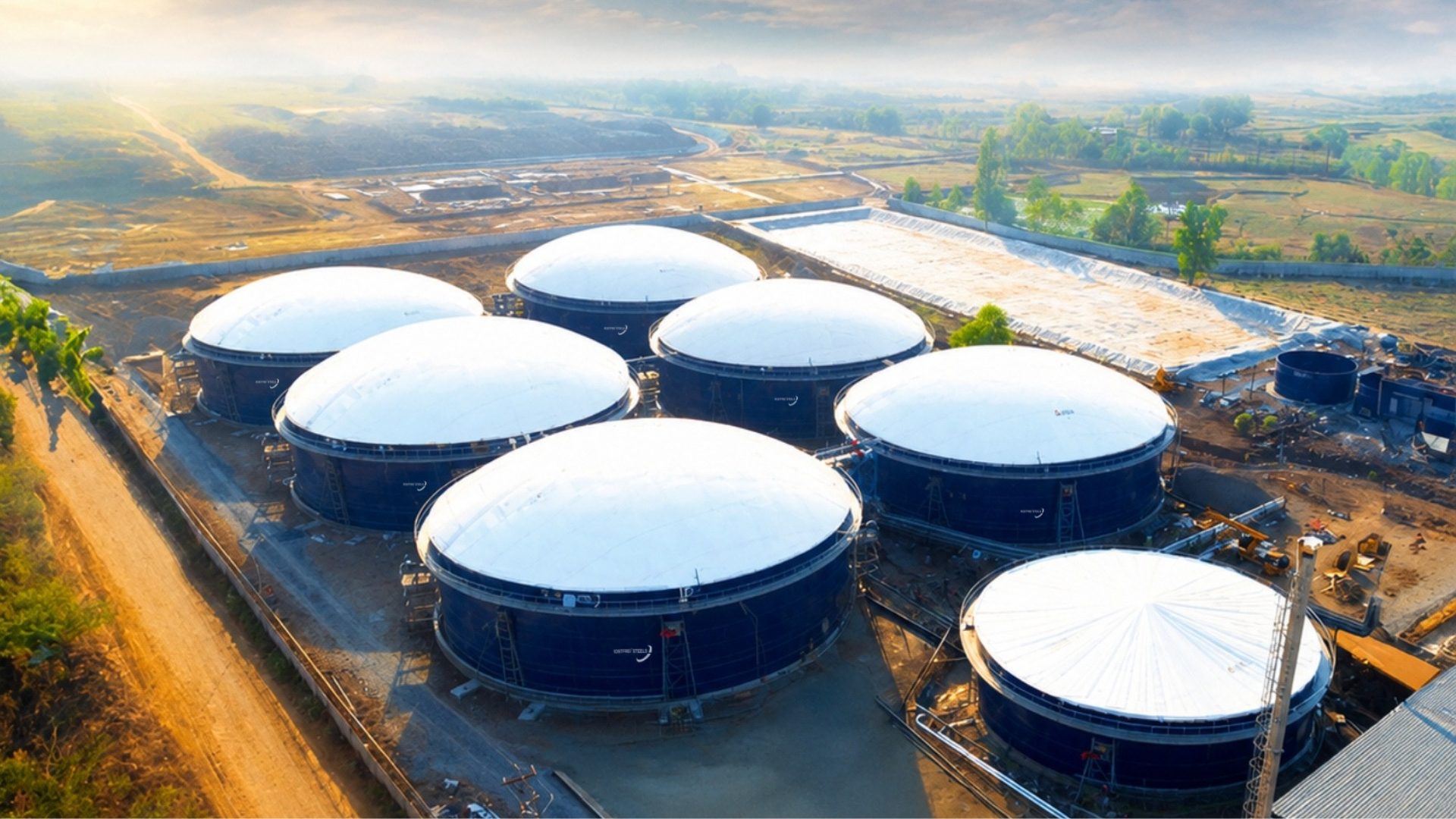
Biogas is becoming an important source of renewable energy as industries, agricultural businesses and municipalities look for sustainable ways to manage organic waste and generate clean energy. An efficient biogas plant relies on the biogas digester tank to convert organic waste into biogas through anaerobic digestion.
Choosing the right digester tank is essential for maintaining process efficiency, minimizing maintenance requirements and ensuring long-term plant performance. Moreover, modern biogas projects use GFS tanks for corrosion resistance, modularity, and large storage capacity.
In this guide, we explore how biogas digester tanks work, their major components, benefits, applications and important selection considerations.
What Is a Biogas Digester Tank?
A biogas digester tank is a specially designed vessel that processes organic materials in an oxygen-free environment at biogas plants. During anaerobic digestion, microorganisms break down biodegradable matter and produce biogas, primarily consisting of methane and carbon dioxide. Furthermore,
Common feed stocks include:
- Agricultural and animal waste
- Food processing waste
- Organic municipal solid waste
- Sewage sludge
- Industrial biodegradable waste
The plant uses biogas for heating and electricity or upgrades it to Compressed Biogas (CBG).
How Does a Biogas Digester Tank Work?
The biogas production process generally involves the following stages, which are discussed below.
- Feedstock Preparation: Initially, operators collect, sort, and prepare organic waste for efficient digestion.
Depending on th feedstock, this may include mixing, screening or dilution. - Feeding into the Digester: Subsequently, the feeding system transfers the prepared organic material into the airtight digester tank.
- Anaerobic Digestion: Microorganisms break down organic matter in absence of oxygen.Microorganisms drive this process through hydrolysis, acidogenesis, acetogenesis, and methanogenesis.
- Biogas Collection: The generated biogas accumulates in the designated gas collection system or storage arrangement. Gas handling equipment directs it towards further treatment or utilization.
- Digestate Management: The remaining digested material, known as digestate, exits the system and undergoes processing for suitable agricultural or other applications, subject to its quality and applicable regulations.
Why Are GFS Tanks Used for Biogas Digesters?
Glass Fused to Steel (GFS) tanks combine the strength of steel with a specially fused glass coating. The coating provides a protective barrier against corrosion and helps the tank withstand demanding operating environments. Additionally, Their modular bolted design also allows for faster installation compared to other tank.
Key advantages include:
- Corrosion Protection: The glass coating helps protect the steel substrate against corrosion.
- Modular Construction: Workers assemble plant-coated steel panels and tank accessories at the project site, enabling efficient installation.
- Quality Consistency: Plant – controlled coating processes help maintain consistent panel quality.
- Low Maintenance Requirements: Protective coating can reduce the need for frequent external coating maintenance, subject to operating conditions.
- Scalable Design: The system enables users to customize tank dimensions and capacity to meet project requirements.
- Long-Term Performance: Proper engineering, installation and maintenance support reliable service over the tank’s design life.
Important Components of a Biogas Digester System
A complete biogas digester project involves several interconnected components.
- Digester Tank Structure: The main tank contains the organic feedstock during the digestion process. Its material, dimensions and structural design must suit the project requirements.
- Gas Collection System: Furthermore, this arrangement collects the biogas generated during digestion and directs it towards gas treatment, storage or utilization equipment.
- Mixing System: Furthermore, mixers improve contact between microorganisms and organic matter, prevent settling, and ensure process consistency.
- Heating System: Additionally, heating coils maintain the required digestion temperature when necessary.
- Inlet and Outlet Arrangements: Properly designed inlet and outlet connections support-controlled feeding and digestate discharge.
- Safety and Monitoring Equipment: Project engineers should select pressure protection, gas monitoring, and instrumentation while ensuring compliance with safety standards.
Applications of Biogas Digester Tanks
- Biogas digester tanks are used in several sectors where biodegradable waste is available.
- Agricultural Projects: Processing cattle dung, crop residues and other agricultural waste.
- CBG Plants: Producing biogas for upgrading into compressed biogas.
- Food Processing Industries: Treating biodegradable waste generated during food production.
- Dairy Farms: Managing cattle waste while generating renewable energy.
- Municipal Waste Management: Processing suitable organic fractions of municipal waste.
- Wastewater Treatment Facilities: Treating organic sludge and recovering biogas.
GFS Biogas Digester Tanks for CBG Projects
Compressed Biogas (CBG) projects require reliable digester infrastructure to support the biological conversion of organic feedstock into biogas. The digester tank forms an important part of this infrastructure.
GFS biogas digester tanks offer a modular steel construction with a corrosion-resistant glass coating. Furthermore, engineers can plan their configuration according to project-specific requirements, including feedstock characteristics, process design, operating conditions, and required capacity.
For a successful CBG project, tank selection should be coordinated with the process technology provider and engineering team. Factors such as gas-tightness, structural loading, temperature, pressure conditions and chemical exposure must be evaluated before finalizing the design.
Explore Rostfrei Steels’ GFS Biogas Digester Tanks to learn more about the available tank solution.
How to Select the Right Biogas Digester Tank?
Before choosing a biogas digester tank manufacturer, consider these important factors:
- Required Capacity: Determine the working volume based on feedstock quantity, organic loading rate and hydraulic retention time.
- Feedstock Characteristics: Evaluate the type of organic waste, solids content, pH and chemical composition.
- Tank Material: Select a material and coating system suitable for the operating environment.
- Structural Design: Consider wind loads, seismic requirements, liquid loads and foundation conditions.
- Gas-Tightness: Ensure the complete digester and gas collection system meets specified operating conditions.
- Safety Provisions: Include suitable pressure and vacuum protection, gas detection and access arrangements.
- Installation and Maintenance: Evaluate installation support, inspection access and long-term maintenance requirements.
Qualified engineering and process specialists should develop the final design according to applicable codes and project specifications.
Frequently Asked Questions About Biogas Digester Tanks:
A biogas digester tank provides an oxygen-free environment where microorganisms break down organic waste and generate biogas, though their digestion process.
Depending on project requirements, engineers may construct digesters using concrete, stainless steel, or specially coated bolted steel systems such as Glass Fused to Steel tanks.