Infrastructure development across the world is accelerating at an extraordinary rate. From logistics corridors and industrial facilities to renewable energy plants, data centres, transportation terminals, and temperature-controlled storage, nations and private enterprises are investing heavily in fast and efficient construction solutions.
At the center of this transformation is prefabricated construction a method that has evolved from a niche alternative into a primary driver of modern infrastructure. In 2026, prefabrication is no longer viewed as optional; it has become a strategic necessity for large-scale development.
This article explores why prefabricated construction is shaping the future of infrastructure worldwide and how Rostfrei Steels contributes to this evolution.
The Global Infrastructure Momentum: A Broader View
Economic progress today is closely connected to how rapidly and efficiently infrastructure can be built. Around the globe, growth is being fueled by:
• Expansion of manufacturing and industrial clusters
• Rising demand for warehousing and logistics networks
• Increasing need for cold storage and controlled environments.
• Large-scale renewable energy and utility projects
• Growth of data centres, automotive hubs, and industrial parks
Traditional construction techniques often struggle to match this pace due to extended timelines, material wastage, and inconsistent quality control. Prefabricated construction offers a reliable alternative capable of meeting modern demands without compromising standards.
Understanding Prefabricated Construction
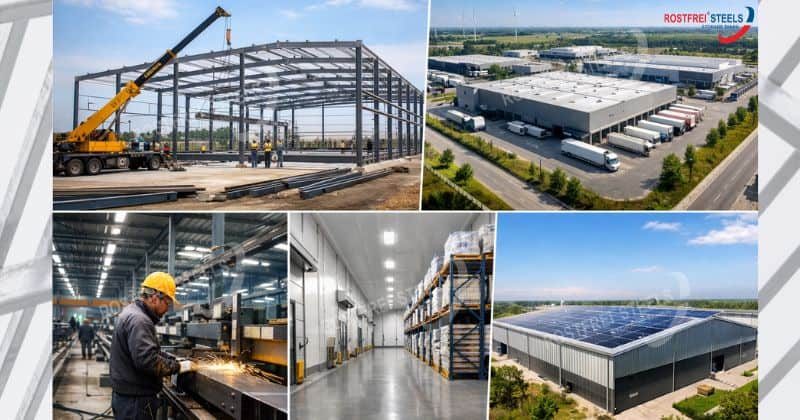
Prefabricated construction refers to producing structural and architectural building components in a controlled factory environment, followed by transportation and assembly at the project location. These components typically include:
• Pre-engineered steel structures (PEB systems)
• Insulated sandwich panels such as PUF, Rockwool, Glass Wool, and EPS
• Roofing and wall cladding systems
• Modular units and auxiliary site infrastructure
Because fabrication occurs under monitored conditions, this approach ensures accuracy, repeatability, and efficient execution making it especially suitable for large and complex infrastructure projects.
Why Prefabrication Is Essential for Modern Infrastructure?
1. Accelerated Project Delivery
Speed remains one of the most compelling advantages of prefabrication. While site preparation progresses, building components are manufactured simultaneously, significantly shortening overall project duration. Many developments achieve completion 30–40% faster than conventional construction methods. For sectors where early operational readiness directly affects profitability such as logistics, manufacturing, or cold storage this time efficiency provides a measurable competitive edge.
2. Reliable Quality and Engineering Accuracy
Infrastructure assets are expected to perform consistently over long service periods. Factory-controlled production allows strict quality inspections, standardized fabrication procedures, and precision engineering. This reduces the likelihood of on-site errors, design deviations, and costly rework challenges frequently encountered in traditional builds.
3. Scalability and Future Expansion
Modern infrastructure must adapt to changing capacity requirements. Prefabricated structures are inherently modular, enabling seamless expansion, vertical or horizontal additions, and layout modifications without interrupting existing operations. This flexibility makes them particularly effective for warehouses, manufacturing plants, industrial sheds, and data centres.
4. Sustainability and Energy Performance
Environmental responsibility is now integral to construction planning. Prefabricated buildings support sustainable practices by minimizing material waste, lowering carbon emissions, and incorporating high-performance insulation systems. Enhanced thermal efficiency reduces long-term energy consumption for cooling and heating, aligning with global sustainability objectives and regulatory frameworks.
5. Suitability for Industrial and Public Infrastructure
Prefabricated construction aligns well with the performance and compliance needs of both private and government-backed projects, including:
• Warehouses and logistics facilities
• Cold storage and food processing units
• Industrial production plants and assembly lines
• Renewable energy and utility buildings
• Airports, transit hubs, and institutional structures.
These projects demand durability, rapid execution, and regulatory adherence areas where prefabrication consistently excels.
The Impact of Advanced Manufacturing Technologies
The efficiency of modern prefabrication is driven by technological innovation in manufacturing and design. Key advancements include:
• Automated steel fabrication and CNC processing
• Continuous panel production lines for insulation systems
• High-precision roll forming and profiling equipment
• Advanced digital design tools and BIM integration
Such technologies deliver uniform product quality, superior structural performance, and faster production cycles critical elements for meeting global infrastructure timelines.
How Rostfrei Steels Supports Infrastructure Development
Rostfrei Steels contributes to global infrastructure progress through a comprehensive portfolio of engineered prefabricated solutions. Our capabilities include:
•Pre-Engineered Steel Buildings for industrial and commercial applications
• Insulated sandwich panels designed for thermal efficiency and controlled environments
• Precision fabrication supported by modern manufacturing facilities
• Custom engineering tailored to climate conditions and load requirements
• End-to-end project support from design and manufacturing to delivery coordination
Our focus is on delivering structures that combine strength, efficiency, and long-term reliability while meeting international quality benchmarks.
Prefabricated Construction: Building the Present and the Future
By 2026, prefabricated construction is not merely a trend it is an established foundation of the global infrastructure ecosystem. Its ability to deliver:
• Faster completion timelines
• Consistent engineering quality
• Scalable expansion possibilities
• Energy efficiency and environmental systems
• Reduced lifecycle costs
Positions it as the most practical and forward-looking construction methodology available today.
Conclusion
As infrastructure expansion accelerates across industries and regions, prefabricated construction continues to emerge as the most dependable and efficient building approach. From industrial complexes and logistics networks to renewable energy facilities and public infrastructure, prefabrication enables rapid progress without sacrificing quality or sustainability.
Rostfrei Steels remains committed to empowering this growth by providing engineered, energy-efficient, and future-ready steel building solutions designed for the demands of modern infrastructure worldwide.